Pregnancy diagnosis
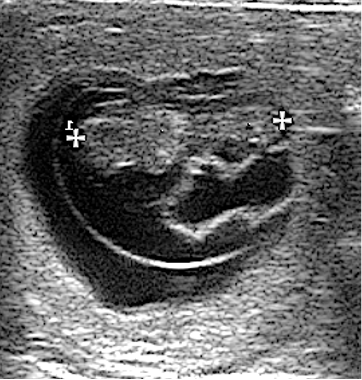
Ultrasound is extremely accurate and safe for confirming pregnancy, although it can’t give an exact count of puppies, especially in large litters. We have the experience and equipment for all your small animal pregnancy ultrasounds.
When to ultrasound
An ultrasound can be done from about 3 to 3½ weeks after mating if progesterone tests were used to find the ideal mating day. Without progesterone testing it’s better to wait until 4 weeks after mating. Later scans are possible but puppy counts become less accurate.
Early scans can detect resorptions, where a foetus dies and is resorbed. One or two resorptions are common in a large litter.
X-rays
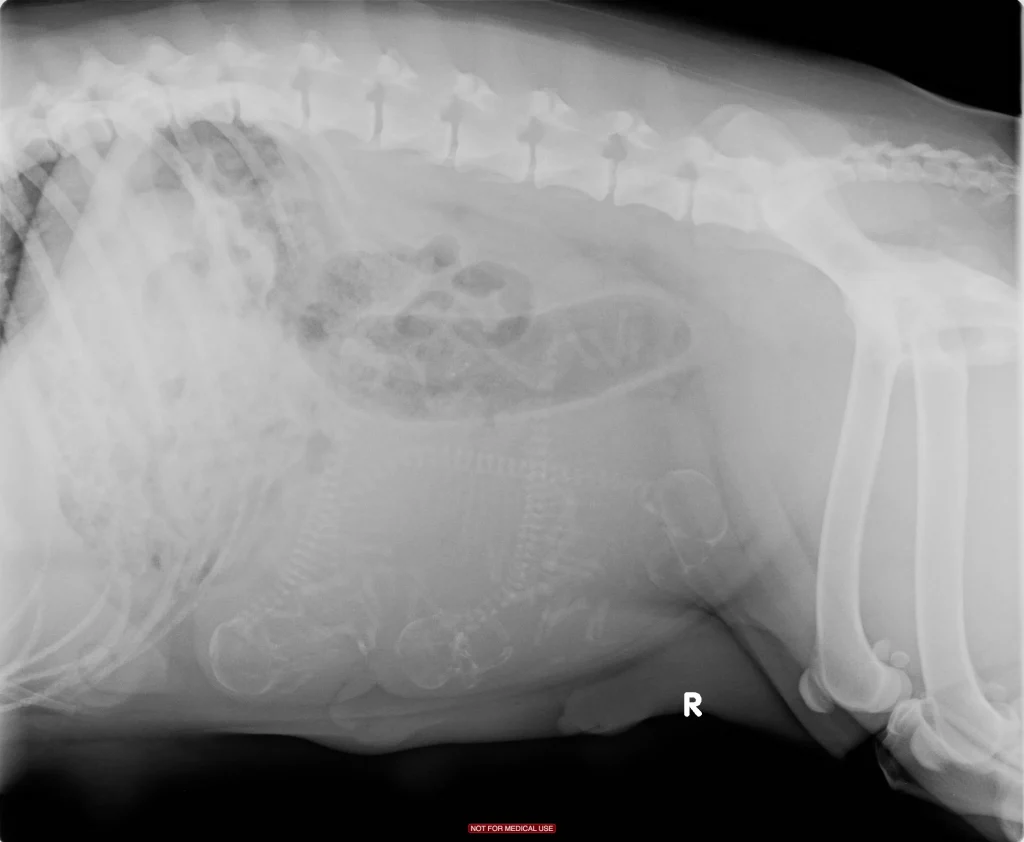
Radiographs taken in the last week of pregnancy give a more accurate count of pups.
Estimating the due date
From mating dates: pregnancy lasts on average about 63 days from the first mating, so add 63 days for an approximate whelping date. The real date can vary from 58 to 72 days because of the wide gap between mating and conception.
More accurately: if ovulation is detected with progesterone blood tests during her heat, the whelping date can be predicted far more precisely. An ultrasound can also help.
Feeding
Pregnancy: most foetal growth happens late in pregnancy, so she needs more food in the last 4 weeks. As a guide, from day 40 feed an extra 10% per day, divided into smaller meals.
Lactation: a lactating bitch needs much more food — as a rule of thumb about three times her normal amount (if she normally eats 2 cups a day, increase to 6). Without enough she can’t feed her pups, will lose weight and can develop a life-threatening condition. Feed several meals through the day.
Whelping
Signs of impending birth: she may be restless for several days, seek or refuse attention, refuse food, and nest the day before.
First stage usually lasts 6–12 hours (up to 36). Her temperature drops by about 1 °C to around 37 °C. You may notice contractions and her belly dropping as the pelvic and abdominal muscles relax.
Second stage usually lasts 3–12 hours (up to 24). The first pup is usually born within 2–4 hours, with 5 minutes to 2 hours between pups. Temperature rises to about 38–39.5 °C. Look for clear foetal fluids and visible straining. About 60% of pups are born head first; the mother breaks the membranes, licks the pup and severs the cord.
Third stage is the resting stage within 15 minutes of each birth.
Whelping problems
Problems depend heavily on breed. The most common is primary uterine inertia (about 50% of cases), where labour doesn’t start — vigorous exercise may help, and contact us if it doesn’t. Partial uterine inertia (about 24%), where labour starts then stops, may also respond to exercise. Foetal blockage (about 24%) needs immediate veterinary attention — a pup trapped in the birth canal is serious.
When to seek veterinary help
- A greenish or red-brown discharge but no pup within 2–4 hours of second stage labour
- Foetal fluid passed more than 2–3 hours ago and nothing more has happened
- Weak, irregular straining for more than 2–4 hours
- Strong, regular straining for more than 20 minutes without a pup
- More than 2–4 hours since the last pup and more remain
- Second stage labour for more than 12 hours
We may be able to provide an on-call service for whelping bitches — this must be arranged beforehand, and treatment is always at the clinic. See also Caesareans.
Pregnancy termination
Pregnancy can be terminated medically. It’s important that this is done properly to protect future breeding — we can help.